
Here we describe the first trio in 'the gang of nine' - categories of digital tooling for organising, collaboratng and facilitating in civil society and the real economy.
Trio #1 - Basic text communication
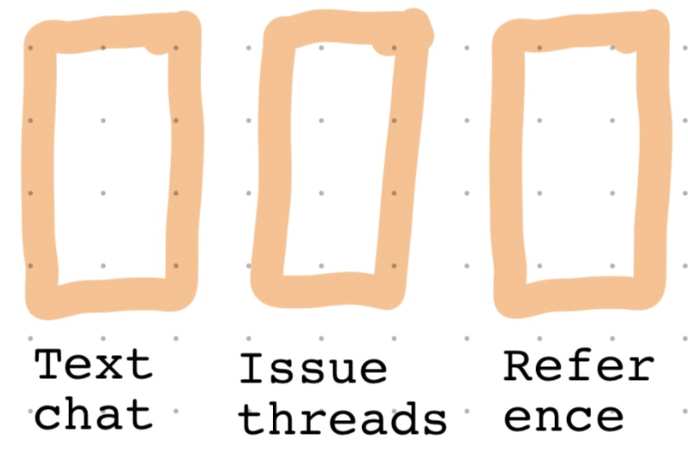
This is basically the 'trinity' proposed by Rich Bartlett and Nati Lombardo. Already, in this brief summary below, you can see how one class of affordances maps into many apps or platforms, and how one platform or software stack furnishes numerous affordances.
# Text chat Synchronous messaging, endlessly scrolling off the screen, hard to retrieve. What's in view is current and contextual. Folks are very used to doing this, in a variety of messaging apps.
WhatsApp is notoriously prominent, Signal is preferred by some disciminating people, hackers like Matrix, an increasing number of folks use Mastodon (which is also called 'micro blogging'). Matrix and Mastodon are **protocols**, not apps, embodied in numerous client apps. Even sophisticated Hylo can be used in chat mode.
# Issue threads Extended discussion, under topics or subjects, supporting deliberations and building up shared perceptions and shared contexts. Traditionally this might be done in a **forum**. Often it still happens in email, perhaps via a **listserv**.
Threaded discussions are basically asynchronous even if they trigger notifications and some people read them immediately. A thread enables people to be in the loop even if they aren't in the same timezone, or if they have irregular access (shiftworking for example, or childcare).
In recent times folks jump into a corporate-user platform like Slack or RocketChat, though FLOSS folks might use that old multi-function workhorse, Discourse (which adopts Markdown protocols). Hylo was evolved to serve threaded conversation in elaborate, evolving networks of groups and subgroups.
# Reference Libraries, repositories, FAQs, handbooks etc: curated collections of documents intended to be durable and perhaps even foundational. Curated collections can include video and other media (thus 'digital documents' in the broadest sense) but basically we're talking text documents.
This takes many forms, many of them pretty much rely now on shared **documents in the cloud**: see the second trio. Second trio - Affordances for persistent and live collaboration
A **wiki** is a classic form for an evolving collection of common 'wisdom' or 'living documents'. Wikis will often include a 'threads' dimension too \[First trio] - like Wikipedia does, for Wikipedians. Wikis are often badged as **knowledge bases**.
Mediawiki is widely used wiki tooling. Federated wiki is a whole other game of 'chorus of voices', invented by same programmer as the now-universal wiki principle. Obsidian and Outline are FLOSS 'knowledge base' tooling. The NextCloud stack offers a 'Collectives' view on a repo of markdown files, amounting to a wiki or knowledge base. Even workhorse Discourse can be used to make a kind of wiki.
# Curating Note that the amount of labour invested in curating increases from chat thro threads to reference, alonside the searchability and retrievability. But navigation becomes an issue - not always very well served.
Note also that, while chat is 'current' a repository or knowledge base is 'always in principle out of date'.
And reluctantly, note that in most communities using threaded media not that many people are very attentive to switching subject lines when topics shift; retrievability otherwise could often be much beter.
--- See: Trinity of tools For a review of particular tools, see: - Trio 1 review - Text chat - *xxx to be added* - Trio 1 review - Issue threads - *xxx to be added* - Trio 1 review - Reference - *xxx to be added*