
The DisCO stack is a move beyond the Trinity. The Trinity of tools comprises primary means of being in touch and exchanging understandings, in text media. The stack is much more about knuckling down to working together and actively collaborating, over periods of time.
The stack is about coordination, it's about making things happen; it's about working as a team rather than just kicking ideas around.
In the slide below this is expressed in terms of coops but campaign organisations, and 'movement' organisations generally, can be approached in the same way - as, inded, can teams and workgroups within organisations.
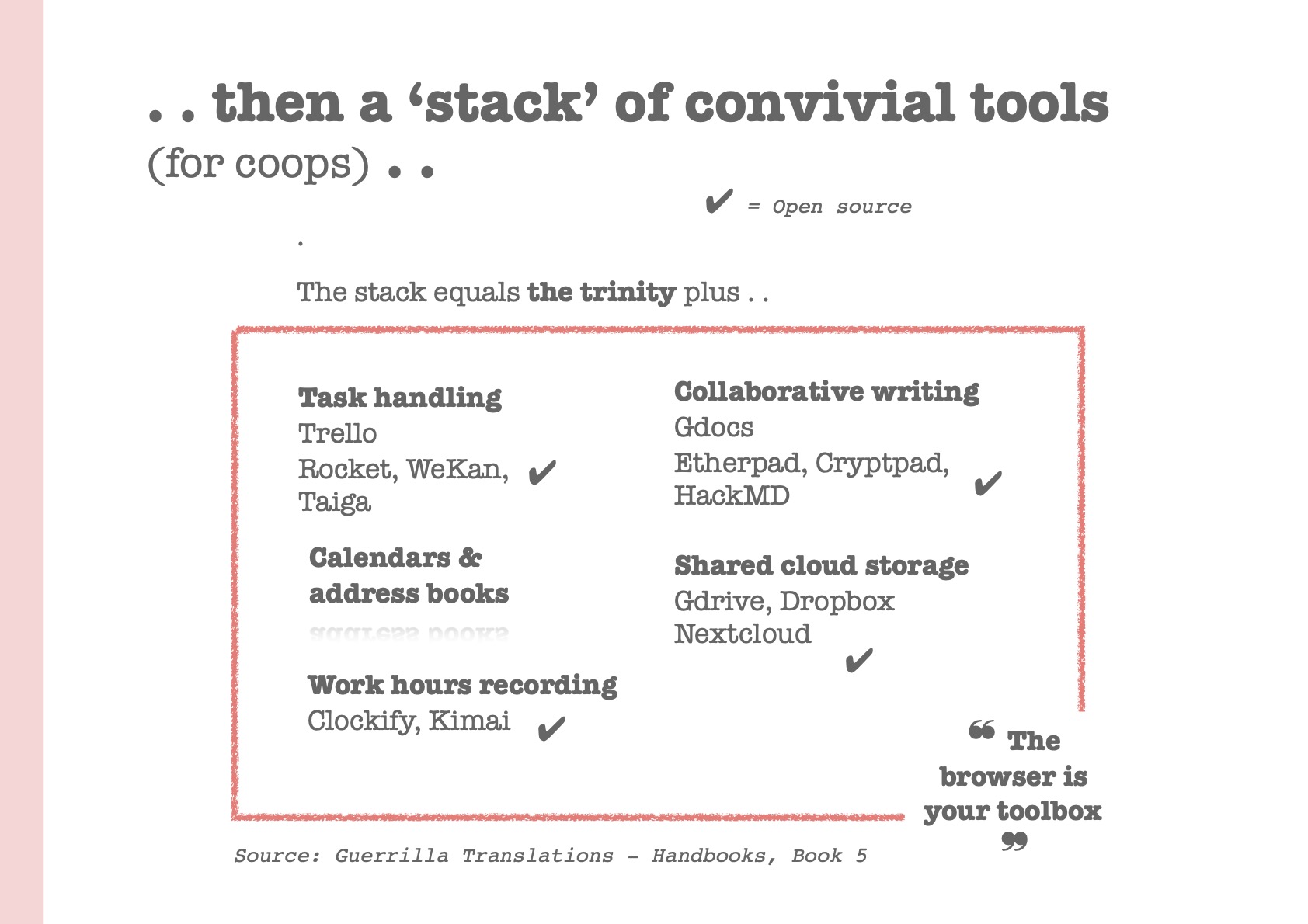
Convivial tools - The DisCO stack
Guerrilla Translations, who coined this idea of the stack, call these five classes of tools *convivial tools*. What they're referring to is Ivan Illich and his notion of **tools for conviviality**.
'Tools for conviviality' is definitely a way of thinking that warrants a lot of attention now; *again*. It was first voiced 50 years ago but there is a lot that we still don't do, or aren’t very fluent in, or haven’t interpreted yet, in practical digital terms. Ivan Illich > Illich 1973, Tools for conviviality
# Five categories of tools in the DisCO stack **Task handling** is one of the stack applications. People might use *Trello* for this, there are various kinds of 'kanban' systems: WeKan, Taiga, Focalboard. If you're seriously doing complex things you've got to handle tasks across groups: some way or other you've got to (collectively) know who's doing which task, whether it's done yet, what stage it's at. Sometimes you even need an app to help in this!
Next: **calendars and address books**. It's kind of obvious and mundane, but we can't manage without them. Some people picture this in terms of client relationship management tools. Generalising, we could tag this type of tool as handling **shared links** with the other actors in the collaborators’ shared world.
If you're collaborating together in certain ways - especially when livelihood work is involved - then you're going to need to **record work hours**. This is not only about getting paid, it's also about fairness and about recording transparently and routinely who's doing what. It's about being able to look at your own balance of labor, too - your own range of contributions - and reflect on it. Since contribution economy is a key principle in the Democratic Tech Fund, and the Economy layer of the real full stack is basic, the question of recording work hours (and other kinds of contribution) is going to come up. Contribution economy
**Collaborative writing**: not everybody is in the writing business, like Guerrilla Translations; but i think every medium to long-term organisation has to collaboratively write something at some time. The 'libraries and repositories' category in the Trinity of tools implies a significant amount of writing - perhaps collaborative writing. So the capacity to collaboratively write is part of the stack.
**Shared cloud storage** became much more visible when DropBox and Gdocs kicked in. On the free tool platforms it's relatively rare to find shared cloud storage as part of what's offered. Collectively filing things is utterly important here if we're in this for the long haul. \[That was written some years back, and shared storage in the Cloud has become ubiquitous since. Hence it moves into the 'extended trinity'.] Extended trinity