
Since we first started thinking about the 'trinity' of digital tools, and added the DisCO stack of collaboration tools, things have moved on. It seems appropriate now to use an 'extended trinity' when thinking about an infrastructure of basic digital means for enabling collaboration.
The framing as 'an extended trinity' is a historical legacy that we probably should leave behind (but aware of it's evolutionary origins). The extended trinity comprises three trios: nine categories in total. So to move forward, we'll adopt a notion of a 'gang of nine': nine kinds of tooling that are implicated in digitally mediated organising, collaborating and facilitating. One way or another, it will be best to have some tooling in each of the nine categories, mobilising and practically integrating all the nine 'families' of FLOSS tools into collective working. Gang of nine
OK, returning to the evolutionary extension of the trinity . .
Some of the DisCO Stack can be promoted to an extended trinity. And some Specials can too.
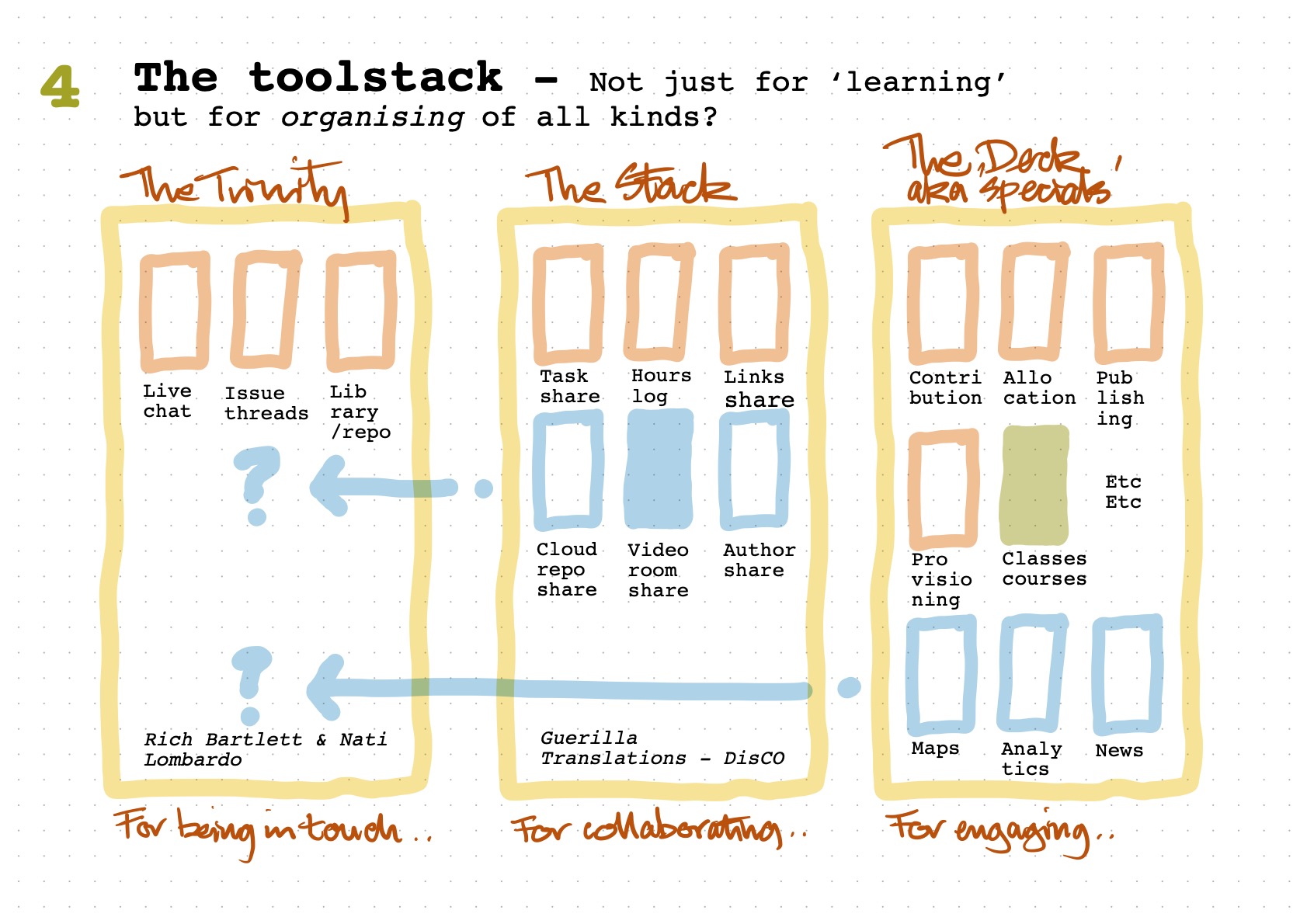
Promoting some elements, extending the trinity
We end up with three trios in 'an extended trinity'.
# Trio 1 - Tools for basic (text) communication
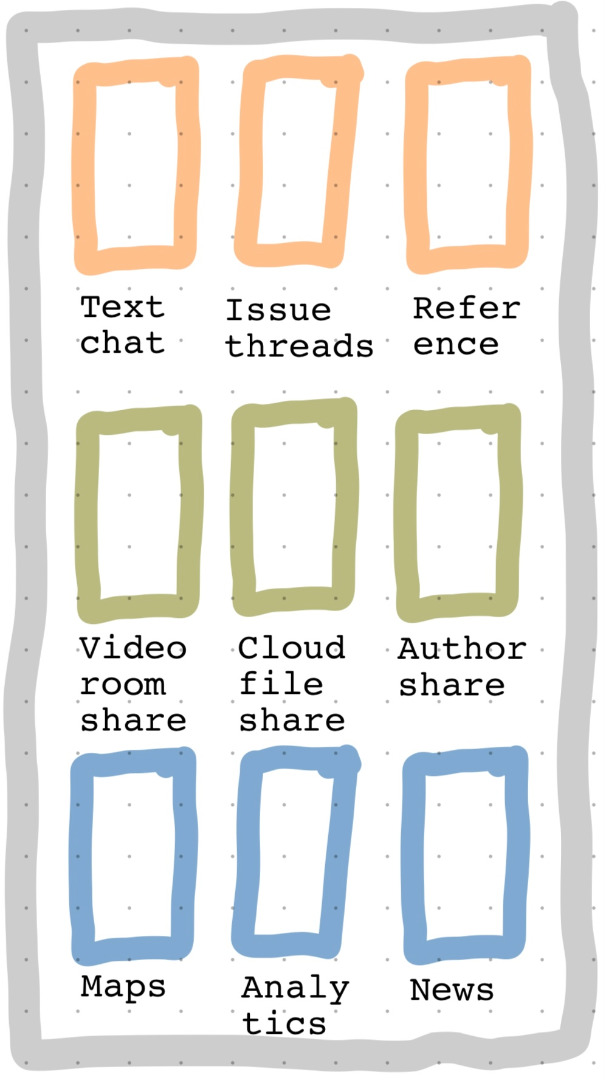
An extended trinity - Three trios
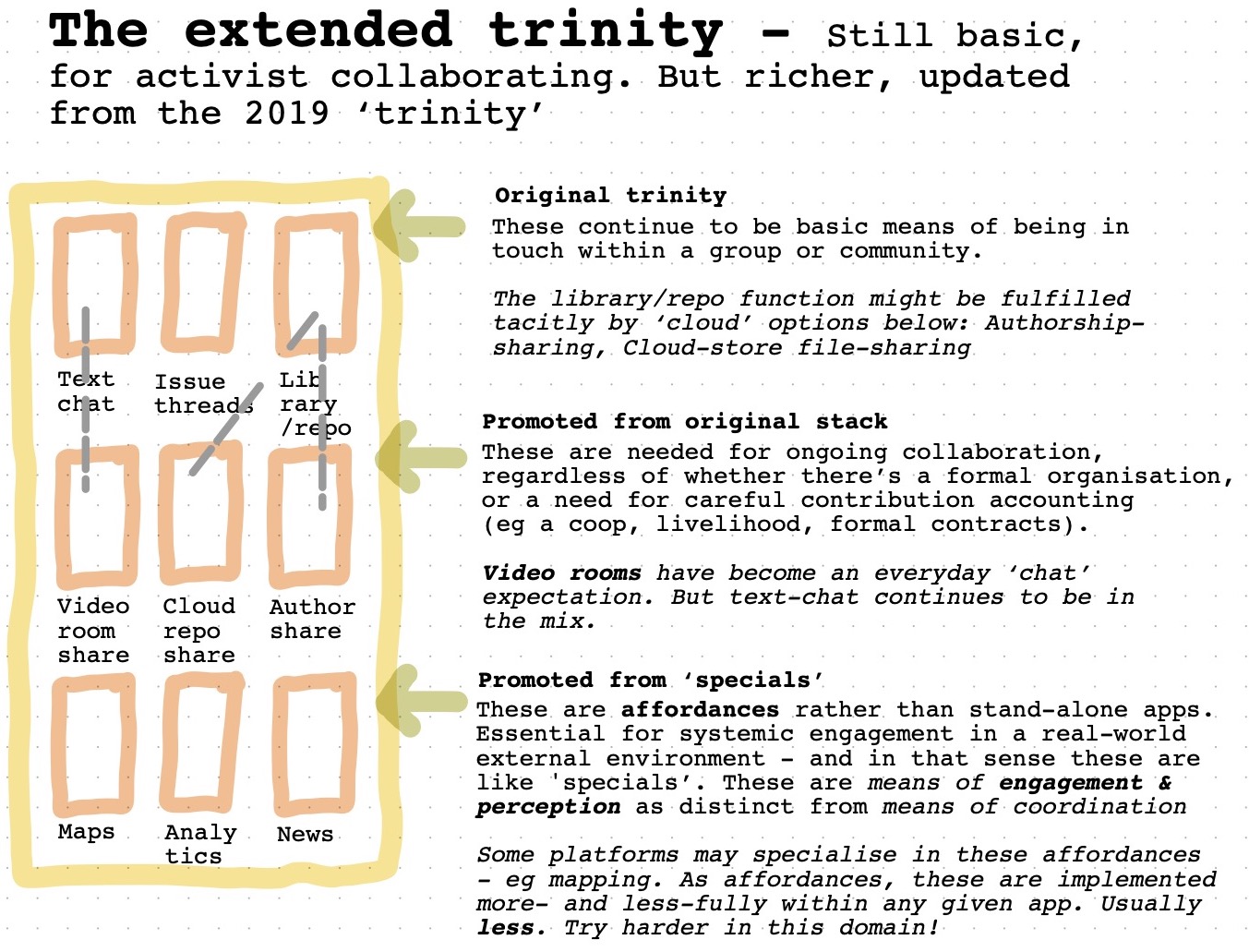
The original trinity remains basic. This constitutes the first trio of an extended trinity, and its categories identify tools for basic text-based communication in a community. Trinity of tools
The categories range from synchronous **chat** (rapidly scrolling out of sight), through **issue-threaded** asynchronous media which to some degree are curated (if people care to change the subject line when the topic changes!), to long-lasting assemblages and repos of highly curated documentary means: **libraries**, handbooks, FAQs, etc.
Three trios of tools in an extended trinity
# Trio 2 - Tools for supporting live collaboration As collaboration becomes more persistent and focused, other categories of tools become significant.
Although text-chat (in the original trinity) continues to be in the mix, in the first trio, **shared video rooms** have become an everyday ‘chat’ expectation. So they join text-chat, in the second trio of an extended trinity. The dotted line on the schema above emphasises the relationship.
**Voice-over-internet** has also become ubiquitous - phone calls over WhatsApp for example - and should be seen as part of this 'bundle of affordance' even though it's not 'an app' in the same sense as a video meeting room is an app that needs to be hosted by somebody. Nobody provides VOIP as a sole service, it's taken for granted as 'something my phone does': it's a hidden app that lives in the phone environment, an affordance of a smartphone? But yes, it's a digitally mediated space of relationship, for sure, big-time. For many folks, maybe a majority, it's the anchor of the whole digital-tool ecosystem?
Simultaneous and **shared authoring** of documents and a **shared cloud** store for documents were originally in the DisCO Stack. But they warrant being promoted to an extended trinity, as basic means of collaborating. The usage and availability of both kinds of tools has deepened since the trinity was first proposed. Indeed a combination of these two tools can easily constitute a capability for creating a 'library/repo/handbook/FAQ/etc': an element of the first trio and the original trinity. Thus, dotted lines join these elements in the schema above.
# Trio 3 - Tools for mapping and navigating The third trio of tools in an extended trinity comprises means for supporting the active engagement of the members of the collaborating community, with their common context, and for locating themelves in relation to their environment. In this sense they're similar to tools that we regard as being in the 'specials’ category: supporting a specific rather than a generic kind of engagement of a community.
The 'trinity' framework gets a bit more subtle here, because the elements in this 'mapping and navigating trio' are basically **affordances** rather than necessarily appearing as stand-alone apps. Affordance
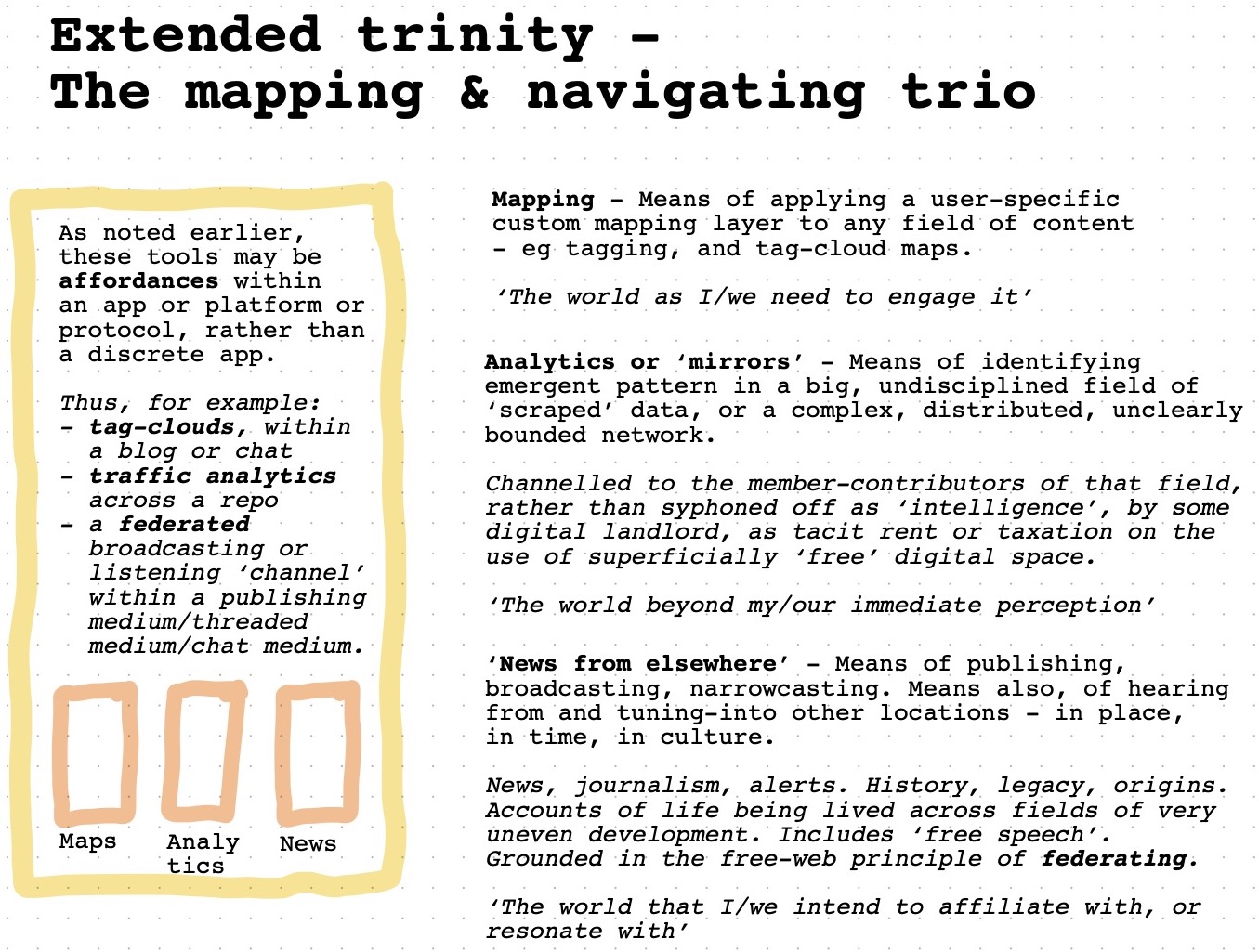
A trio of tools supporting perception, mapping, navigation and engagement
**Mapping and tagging** - Means of applying a user-specific custom mapping layer to any field of content - eg tagging, and tag-cloud maps. Also includes actual topographic maps on which places, people or resources of interest can be tagged; also by extension includes address books, mailing lists and calendars (which are in the DisCO Stack). >Affordances for custom mapping and tagging identify elements of *the world as I/we, specifically, need to engage with it*.
**Analytics or ‘mirrors’** - Means of identifying emergent pattern and relationship in a big, undisciplined field of ‘scraped’ data, or a complex, distributed, unclearly bounded network or ecosystem. This is a major element of the 'Mirrors' layer in the real full stack.
These tools (affordances) need to be channelled to the participant-contributors in that field, rather than syphoned off as ‘intelligence’, by some digital landlord or territory-baron, as tacit rent or taxation on the use of some superficially ‘free’ digital space (eg social media). We don't mean 'trending' and other 'follow-me' clickbait. We mean abstractions of phenomena that emerge in the aggregate, that are tuneable rather like a sonar scan or a survey.
Of course this is the field where so-called AI (pattern recognition, machine learning, algorithms trained of large language corpora, self-modifying constellations of algorithms) has become profoundly significant since the Trinity was first proposed. >Affordances for mirroring or analytics-generation identify *the world that is evolving, beyond my/our immediate perception, where I might see myself as an actor in a non-obvious relationship*.
**‘News from elsewhere’** - Means of publishing, broadcasting or narrowcasting. Means also, of hearing from and tuning-into other locations - in place, in past, present or future time, in culture: beyond the reach of immediate peer-to-peer relationship.
Includes news, journalism, notifications. History, legacy, origins. Fiction, science fiction, future fiction, climate fiction. Accounts of life being lived across fields of very uneven development. Includes ‘free speech’. Grounded in the free-web principle of **federating**. >Affordances for news from elsewhere identify *the world that I/we intend to affiliate with, or resonate with*.
--- Affordances in this third trio may or may not be implemented in a specific app or platform (although perhaps they might be a **protocol**). They may - like tagging for example, or 'AI' functionality, or notifications - be affordances available inside or alongside many kinds of tools.
But we need such affordances to be fluidly available whatever tool we happen to be working with at any time. They might reside in the operating system of the device and its UI, or in network protocols, rather than in 'an app', inside the specific window of a specific tool.
This is much simpler (?) with laptop operating systems and their WIMPS UI than in mobile operating systems, with their single window? But that's how most of the world does things these days 🙄 The phone, the laptop and the big screen