
The framework of Trinity and DisCO stack is concerned with generics: basic text-based means of communication amd basic activities of collaboration. DisCO also identified a set of tools that was called the Disco Deck. These were more specialised tools, related to the field of activity of Guerilla Translations as a coop. Trinity of tools DisCO stack
In different spheres - in different economic or cultural sectors - a range of more specialised tools may be needed in that environment. DisCO called these 'a deck'. We call them 'specials'.
In 2020 we saw specials in this (limited) way.
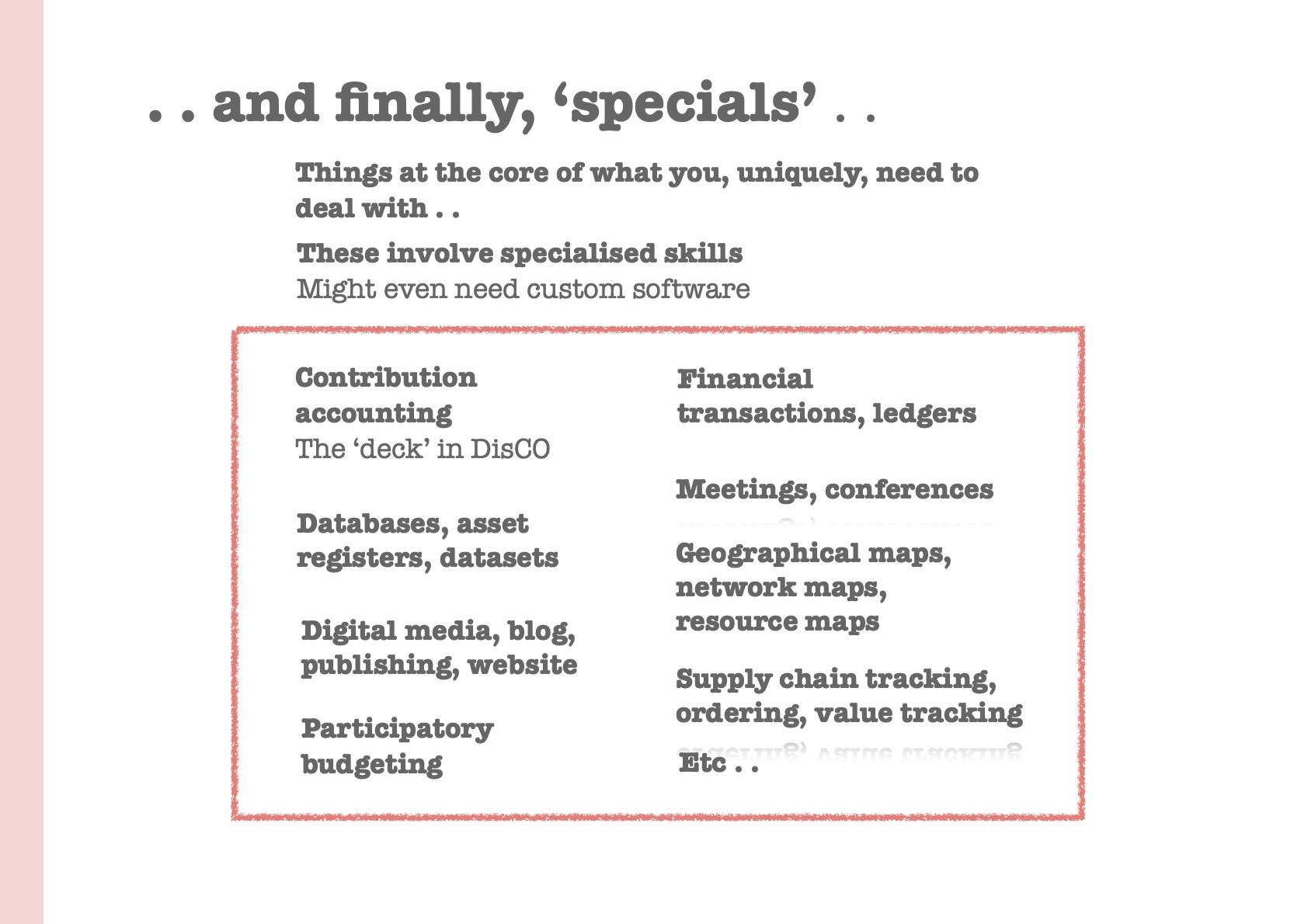
Specials - Varying with the particular stuff you engage with
This original perception of Specials can be evolved, in view of developments that have arisen since 2020 when it was first sketched as above. Some of the elements can be regarded now as being required in any practice that seriously engages with the world out-there, on any significant scale (even if the tools are less familiar, and the skills more specialised). Contribution accounting is one such. So, some specials might be promoted into an 'extended trinity' of basic tools. Extended trinity.
Here are the original specials.
**Contribution accounting** is very important to the guys in the DisCO model of governance for instance: who contributes, and what? They have a sophisticated idea of contributions (arising in feminist economics) and they need to be able to track it, in order to be able to value the contributions fairly, and give recognition fairly, and distribute payments or benefits transparently. In any ongoing collaboration, people do time tracking in some way (tools that do this are part of the DisCO Stack). Few do principled contribution accounting; more should.
**Databases**, membership registries, asset registers, handling large volumes of assembled data. Research or survey organisations stand or fall on their capacity in handling data. More people should handle more data, but digital data literacy isn't that widespread. Our enemies are better at it, generally. Indeed, this is at the heart of the 'Mirrors' layer in the real full stack. Mirrors layer
**Digital media** is a specialised area, needs special tools for production and distribution: video, streaming media, collections of media, etc. Not every organisation or community has to get deeply into this domain. But every person and their dog has some kind of social media presence: Facebook page, website, blog, Snapchat feed. Only some of which are in any sense capably managed (curated). >Many love to dabble here - on corporate platforms, like YouTube and Vimeo - where our comings and goings are tracked and profiled. Our audio is robot-transcribed, even; and text-scanned and profiled. So few people understand the scope of power that this gives the corporate platforms - and the 'security' agencies. It may be artificial, but 'intelligence' in its good old-fashioned sense of engaging the enemy, is alive and well in digital infrastructure. This also is an aspect of the Mirrors layer.
**Participatory budgeting** is not for everybody either, but when you do you really need the tools for it . . *Cobudget*; at municipal scale, *Decidim*. Tools for participatory budgeting are absolutely basic in the work of a Democratic Tech Fund, of course.
Financial transactions, **ledgers**: again it's not something everybody has to do every day. But if that's where you're working you need tools for that. Establishing infrastructures of different *machineries of exchange* (plural) is profoundly important in making a living economy. And I don't mean blockchain currencies, aarghh.
**Supply chain tracking (provisioning)** is profoundly important, even though a relatively small proportion of organisations do this. Any organisation that trades, or furnishes the material needs of a community (food, care, clothing, accommodation . . personal proitective equipment, vaccines . .) needs tools for supply-chain and value-chain tracking. Some radical means for this are in the pipeline: not a day too soon. The corporations of post-Fordism have a head start on us. *Machineries of provisioning* matter.
--- And so on . . engagements with different kinds of sectors of activity in the world - specifically, different *economic* sectors - call for specialisation of the tools that we may need. And the **skills** to mobilise them effectively.
At this level, things get complicated: divisions of labour and skill get complicated. The Democratic Tech Fund will, in due course, need to consider a wide range of infrastructural requirements across diverse sectors of economy and of culture. We bring a focus on these issues here: - Back office toolstack for a fund - supporting capability within the Fund as a mission-focused **organisation**. - Front end tools for a federation - supporting capability within the broad federation of organisations and individuals associated with the Fund and sponsored by the Fund: a **cultural commons**. - A real full stack - of capabilities in communities, **in civil society and in the real economy**, that we mean to facilitate through contra-infrastructuring.