
Here we identify a number of kinds of tooling that may support digitally mediated organising, collaborating and facilitating in civil society and in the real economy. We refer to this framing as a 'gang of nine'; the categories are grouped in three trios.
The 'gang of nine' is a revised name for an 'extended trinity'. This framing evolved from the 'trinity' proposed by Rich Bartlett & Nati Lombardo of Enspiral, and was expanded via the DisCO toolstack and DisCO deck. It ended up containing THREE 'trinities'. Extended trinity
This framework here is particularly relevant to the 'Toolstack' layer of a 'real full stack' approach to digital contra-infrastructure(ing). Toolstack layer
Here we describe the tech layers of the full stack. We refer to them collectively as 'the tech region' of the real full stack.
# Tooling, affordance, tools for conviviality Rather than let the focus fall into 'tools' - which might reify a *social* relationship; a **practice** - we try to work in terms of: - **'tooling'** (an active, attentive, practice of designing and contextualised, evolutionary making) - the availability of **affordances** in practical settings that include material 'stuff', and - an active cultural engagement with the cultivation and protection of **'tools for conviviality'** in the cultural commons. All these terms - tooling, affordance, tools for conviviality - call for further clarification.
‘Tools for conviviality’ is a construct put to work by Ivan Illich, which promotes the principle of vernacular knowing in communities.
To be clear: we're working here with affordances furnished by tools in practical settings of **collaborative social relationship and mutual oreintation**, and in combination with other material elements: other tools, operating systems, devices and their interfaces, physical and geographical spaces, physical capabilities of users; etc. Affordance is here Affordance - *to be added xxx*
> We won't be creating shopping lists of apps. One consequence of this plurality is that a single 'function' within the Gang of Nine may not be furnished by a single 'tool' or app, in isolation. What's in question is the whole **constellation** of perceptions and actions that are afforded to a person at a given moment: its elements might arise in various discrete apps - separate windows on a desktop or in browser tabs - and some arise in the device's operating system (like 'search', for example; or 'drag'). Thus in this page we won't be creating shopping lists of apps that perform distinct functions. We'll go into shopping lists in other pages where we explore tooling within a particular layer of a 'stack' of digitally mediated fields of practice. A real full stack
We find ourselves needing to work not only with an extended trinity of tools, but also with a pretty extended notion of UX too. We get into this under Toolstack look and feel.
# Three trios of tooling
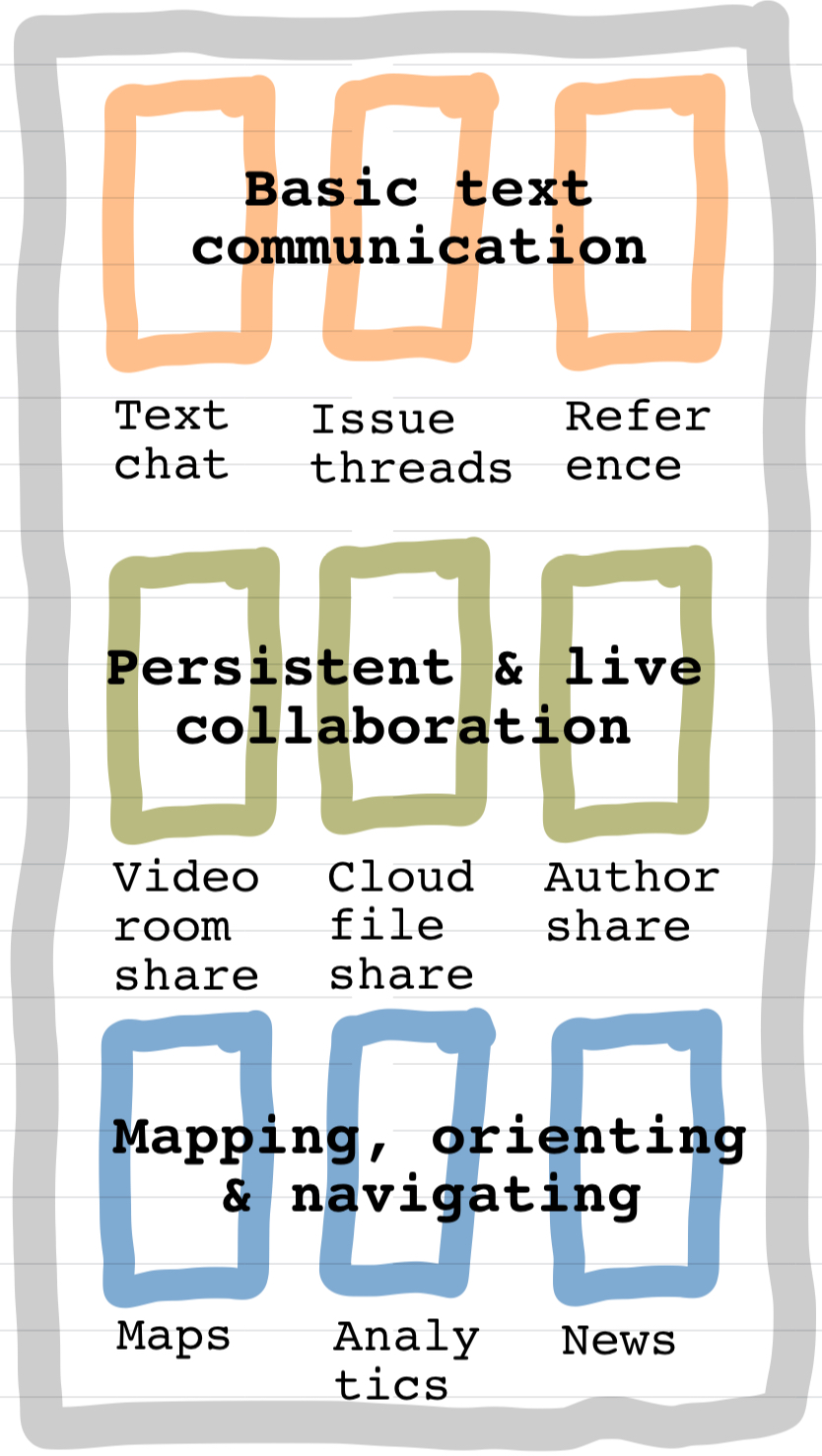
A gang of nine kinds of tooling, in three trios
See: - First trio - Affordances for basic text communication - Second trio - Affordances for persistent and live collaboration - Third trio - Affordances for mapping, orienting and navigating
See also:
Here we outline the core affordances needed in the digitally mediated spaces of the Democratic Tech Fund, and ways that these might be furnished by specific digital tools, protocols and platforms.