
Here we describe the third trio in 'the gang of nine' - categories of digital tooling for organising, collaborating and facilitating in civil society and the real economy.
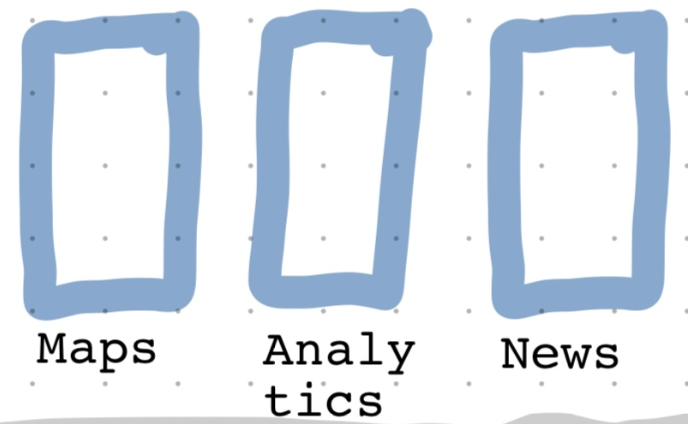
Trio #3 - Mapping, orienting & navigating
These provide tooling that helps cultivate and maintain a sense of orientation within the wider (digitally mediated) world, and a capacity to navigate in an evolving environment. This is important for an individual, and arguably fundamental for members of a community
In this third trio we're in pretty complex territory. But it matters: 'the digital coup' has its foundations here? Largely we're out of the domain of single 'apps', and even explicit toolstacks. The essentially **practical** rather than technical nature of necessary responses becomes pretty obvious.
# Maps We need to add our own meaningful mappings on to what exists in the digital sphere, and to share them. **Contact lists** are a basic old fashioned, pre-digital way of doing this. Literal **geographical mapping** of 'what matters' in relation to 'here' can be powerful: again, pre-digital. **Tagging** of digital media content is a need much less frequently dealt with - but tag clouds can be really helpful.
Sharing **lists of links** is a simple way to approach this need for shared mappings, using a tool like NextCloud Notes for example. But flat lists become klunky pretty fast; some kind of structured (tagged or nested) reference format is needed. Semantic web - data tagged with metadata - is another kind of response to this.
**Archiving** is another aspect of meeting this kind of need - including for example keeping and *filing* web clippings. Eventually we get into the field of **databases** - where many of us are out of our depth. Federated wiki affords a possibility of collectively accumulating resources: the clue is in the name (federated . . get it?).
This kind of affordance is not well dealt with in general. Many apps offer **Favourites** or 'Bookmarks' - and its quite rare to find that these can be managed in a userful way, so flat-file lists of Favourites themselves become unreadable. But it's true that many people don't even attempt to curate their email, and - especially on phones - routinely scroll through a flat-file inbox holding thousands of messages.
This is as much a matter of skill, intention, literacy and putting-in-the attention, as of tooling. Many tools could do the job in some way or another, more or less fully, if folks decided to mobilise these affordances.
**Navigating and searching** - We're broadly into the area of navigating and searching here. Present day operating systems of devices are typically much more powerful at searching on the device than searches on the web tend to be, within a site. Thus for example, navigating folders of files in the web interface of the NextCloud Files app is pretty klunky. But the mirrors of those files, on the desktop of a device, are much easier to search and navigate - especially if the files are encoded within a transparent protocol, like Markdown. In the past 20 years, meticilous management of folder hierarchies and names tends to have been supplanted by vastly more powerful search in the operating system.
Navigation and search within an app or on a website could generally be much improved. A nav sidebar with disclosure triangles at each level of the folder hierarchy seems to be essential for handling a filesystem. But it's not always offered. And there's something 'hyper-spatial' about this whole field, that leaves many folks easily confused. Visual rather than text based presentations may help. They're more like maps!
Intenet search, of course, is the base of the power of one of the most powerful digital elites; the search engine has become ubiquitous, so that 'to google' has become as common as 'to hoover' once was. Bot-powered search is a quite different matter than self-determined 'hand-made' mapping. Google's absurd hubristic ambition, to have 'all knowledge' under review, is extractive and power mad: and typically 'modern'. But we're moving here into the second aspect of this trio: scraping and analytics.
So, as regards tooling for maps, lets emphasise the significance of the **craft** of map making and arisan category-formation (aka ontology), in contradistinction from industrialised word statistics. Let's remember also, that categories have politics. Categories have politics *to be added xxx*
# Analytics With so much digital content and digital traffic - especially through centralised corporate servers like Google and the predominant social media - 'scraping' and powerful analytics on data and metadata is now big business and goes on mostly under the radar of most users' awareness (who regard the service as 'free' and somehow innocent).
'AI' - a terrible misnomer and a label that aggregates a whole array of distinct technologies -is just the most powerful, most recent form of this kind of practice.
This kind of capability is utterly digital. It results from the public exposure and centralised handling of a huge amount of digital traffic, and a capability to 'scrape' it with bots (whose activity now is compromising the behaviour of many websites globally).
Within the 'full stack' of digitally mediated practices, we review issues of this kind as an aspect of the 'Access layer'. Access layer
**Morrors** - Affordances that show 'us' what 'we' are doing, in digital space - the shape of our evolving relationships, beyond immediate peer-to-peer connection and awareness - are much less easy to come by.
We can think of this as furnishing **mirrors** for communities; mirror affordances are a *contra response* to extractive, scraping-and-exploiting practices of Big Tech and state intelligence agencies. How do we do this? It's pretty unclear. Work *much* harder on this.
# News Of course! Reporting 'news from elsewhere' matters enormously. But feeds are a complex, heterogeneous mix. And if we include news from **the past and the future** alongside the present - rigorous historical perspective, 'organic intellectual' analysis, disciplined imaginative visioning - the situation becoms very complex.
Making adequate provision for 'news from elsewhere' is a big challenge for active communities, and affordances for this are not easy to assess and 'install'. It's doubtful that this need can be met by 'an app' - although there are many news and intelligence services in the marketplace (some of them founded on **our** scraped extracted data).
We should note how much significant development in this area has come in the past 30 years from radical media organisations - following on Occupy and the Battle of Seattle for example. We also should note the 'old' movements for community radio. and the 'new' movement in podcasting.
This helps us see that while digital means can be critical, we're basically looking at cultural practices here, and **'tools for conviviality'** in Ivan Illich's sense, rather than any simple kind of app or digital tool.
‘Tools for conviviality’ is a construct put to work by Ivan Illich, which promotes the principle of vernacular knowing in communities.
--- See also: Extended trinity
For a review of particular tools, see: - Trio 3 review - Maps - *xxx to be added* - Trio 3 review - Analytics - *xxx to be added* - Trio 3 review - News - *xxx to be added*